A/B Testing Prompts in Production: Traffic Splits, Guardrail Metrics, and Automatic Rollback
9 min read · Last verified August 8, 2026
You do not need a prompt-management platform to A/B test prompts. If you already run a feature-flag service and a metrics pipeline, you have both pieces: a consistent traffic split and somewhere to compare the arms. What you need on top is the part the tooling cannot give you, which is deciding what "worse" means when the output is a paragraph of English rather than a number.
That decision is the whole guide. Versioning the prompt and rolling it back in one step is solved and covered in the track. Here we cover what happens between shipping version 5 and trusting it: splitting traffic without corrupting the experiment, choosing metrics you can actually observe in production, and writing an automatic rollback rule that fires on real regressions instead of on noise.
Split on a stable key, not per request
The split itself is a hash, and the only rule that matters is what you hash.
import { createHash } from "node:crypto";

// Hash a stable identity, never the request. Same user, same arm, every time.
export function assignArm(experimentId: string, subjectId: string): "control" | "candidate" {
  const digest = createHash("sha256").update(`${experimentId}:${subjectId}`).digest();
  return digest.readUInt32BE(0) % 100 < 10 ? "candidate" : "control"; // 10% candidate
}
Randomising per request is the mistake that looks harmless in a diff and ruins both the experiment and the product. A user who sends three messages gets three coin flips, so a conversation changes voice and format mid-thread, which reads as a bug rather than as a test. It also breaks the arithmetic: your "10% of traffic" becomes 10% of requests, so heavy users are spread across both arms and the difference you are trying to measure gets averaged away.
Include the experiment ID in the hash. Without it, every experiment you ever run puts the same users in the candidate arm, and after three experiments you have a permanent unlucky cohort absorbing all your regressions.
One more constraint specific to prompts: prefix caching keys off the literal prompt text, so two arms mean two cache prefixes. Expect the candidate's cache hit rate to start near zero and its latency to look worse until the cache warms. Do not read the first few minutes as a regression.
Pick metrics you can actually observe
Here is the trap. The thing you care about is answer quality, and quality is not directly observable in production: nobody labels live traffic. So you steer on proxies, and the useful ones split into two groups that get treated very differently.
| Metric | Machine-checkable? | Use it for | How it misleads |
|---|---|---|---|
| Schema validation failure rate | Yes | The auto-rollback trigger | Only catches malformed output, not wrong output |
| Refusal rate | Yes | Auto-rollback trigger | A stricter prompt should refuse more; know the intent |
| Output length distribution | Yes | Early warning | A shift signals changed behavior without saying if it is worse |
| p95 latency and cost per call | Yes | Guardrail | Confounded by cold prompt caches early in a rollout |
| Retry and repair rate | Yes | Guardrail | Rises when output drifts from the schema, a good leading signal |
| Thumbs-down, edit rate, escalation | No, lagging | The actual quality call | Slow, sparse, and biased toward users who complain |
Only the machine-checkable rows belong in an automatic rule. They are cheap, they are unambiguous, and they are available within seconds. The lagging product metric is the one that tells you whether the prompt is genuinely better, and it belongs to a human reading a dashboard the next day.
Pick exactly one product metric before you start. Choosing it afterwards, once you can see the numbers, means you will find a metric that says what you hoped, every time.
Automatic rollback: the rule that fires at 3am
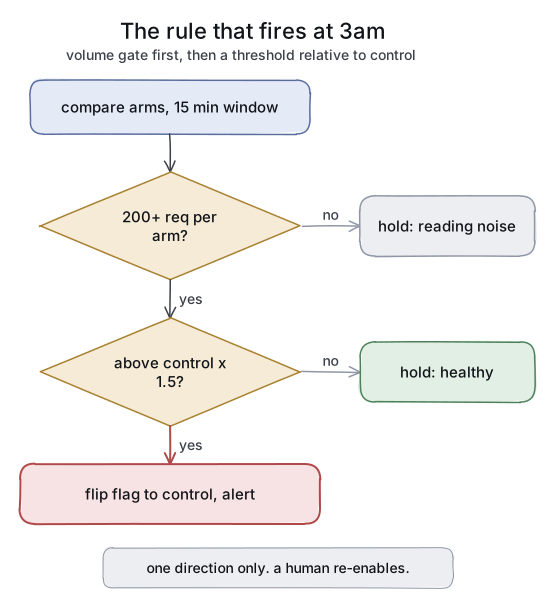
An auto-rollback rule needs three parts, and the third is the one people skip.
// Relative to control, not an absolute number: both arms drift together when
// the provider has a bad hour, and only the gap between them means anything.
const GUARD = {
  metric: "schema_validation_failure_rate",
  minRequestsPerArm: 200,   // below this, the rule is reading noise
  maxRelativeIncrease: 0.5, // candidate may be up to 50% worse before we act
  windowMinutes: 15,
};

export function shouldRollBack(control: ArmStats, candidate: ArmStats): boolean {
  if (candidate.requests < GUARD.minRequestsPerArm) return false;  // not yet
  if (control.failureRate === 0) return candidate.failureRate > 0.02;
  return candidate.failureRate > control.failureRate * (1 + GUARD.maxRelativeIncrease);
}
Compare against the control arm, not a fixed threshold. When the provider degrades, both arms get worse together. An absolute threshold rolls back a perfectly good prompt during someone else's incident; a relative one does not move.
Require minimum volume. This is the part people skip, and it is why auto-rollback gets a bad reputation. At 20 requests per arm, one malformed response is a 5% failure rate and your rule fires on nothing. The volume gate is what separates a guard from a random number generator.
Roll back by flipping the flag, not by deploying. The rollback path has to be a config read, which is exactly what the versioning lesson builds. If getting back to the previous prompt requires a deploy, the rule cannot act and you are back to waiting for a human.
Then let it alert and stop. Resist making the rule clever enough to roll forward again once metrics recover, because a rule that can flip both ways will flap: it rolls back, the metric recovers because the candidate is no longer serving traffic, so it rolls forward into the same regression. One direction only. A human re-enables.
Sample size, when the output is sampled
Both arms are non-deterministic, so you are comparing two distributions rather than two values. That pushes the volume you need up, in a way that surprises people used to A/B testing a button color.
Rough working numbers: a machine-checkable rate metric becomes usable in the low hundreds of requests per arm. A human-judged quality metric needs thousands, which is why almost nobody makes the final quality call from live traffic alone. The eval suite is what gives you a quality estimate before deploying, on labeled data, cheaply. The A/B tells you whether that estimate survives contact with real inputs.
That division of labor is the practical answer to "how long do I run it": until the guardrails are quiet and the volume is enough that the product metric is not obviously worse. You are looking for the absence of a regression, not proof of an improvement. The improvement was supposed to be demonstrated by the eval before you shipped.
Testing across two providers
The cross-provider version of this question comes up constantly, and it is usually asking two things at once.
If you hold the prompt fixed and swap the provider, you are measuring portability: how well a prompt tuned against one model survives on another. That is a legitimate and useful test, especially if you are evaluating a fallback path that has to serve real traffic during an incident. It is not a fair comparison of the two models.
If you are choosing a provider, port the prompt properly first. Each model has its own habits around formatting, refusals, and verbosity, so a prompt carries an implicit fit to the model it was tuned against (the abstraction lesson is where that seam belongs). Tune a version for each, then compare the tuned versions. Otherwise the incumbent wins every time, because the prompt was written for it.
Either way, keep the model pin in the arm definition. An arm is a prompt version and a model pin, and an experiment that changes both while recording only one is unreadable a month later.
Buy vs build, honestly
Nearly everything written about this subject is published by a company selling a prompt registry, so here is the version with nothing to sell.
Do you need a prompt-management platform?
- Engineers edit prompts, few experimentsBuild: flags + your metricsyou already have the split and the dashboard; the gap is a config read and a guard rule
- Non-engineers need to editBuythe git workflow is the bottleneck, and this is the most common real trigger
- You want per-version eval history freeBuybuilding version-scoped eval storage and comparison is a genuine project, not an afternoon
- Many concurrent experimentsBuybookkeeping across overlapping arms is where homegrown setups actually break
The honest summary: the split and the guard are an afternoon on infrastructure you already operate. What you are really buying from a platform is the bookkeeping, and bookkeeping cost scales with how many people touch prompts and how many experiments run at once, not with traffic. Teams with two engineers and one experiment do not need it. Teams where support leads tune tone across six features do.
If you remember one thing: hash a stable identity so a user stays in one arm, auto-roll-back only on machine-checkable metrics with a volume gate and a relative threshold, and let a human make the quality call from the eval suite plus a dashboard rather than from a rule.
Sources & further reading: Google SRE workbook: configuration design · Martin Fowler on feature toggles · Canary release · How not to run an A/B test (Evan Miller)
FAQ
How do I automatically roll back an underperforming prompt?
Pick one guardrail metric that is machine-checkable (schema-validation failure rate is the usual choice), set a threshold relative to the control arm rather than an absolute number, and require a minimum volume before the rule can fire. On breach, flip the flag back to the control version and alert. The rule that trips at 3am must be cheap and obviously correct; save nuanced quality judgments for a human the next morning.
Can I A/B test the same prompt across two different LLM providers?
You can run the experiment, but be clear about what it measures. Changing the provider and keeping the prompt fixed tests the prompt on unfamiliar ground, because a prompt tuned against one model encodes that model's habits. If the goal is choosing a provider, port and tune the prompt for each one first, then compare the tuned versions. Otherwise you are measuring portability, not capability.
How much traffic does a prompt A/B test need?
More than you would expect, because LLM output is sampled: the same prompt produces a distribution, not a value. For a machine-checkable rate metric like validation failures, hundreds of requests per arm gets you a usable signal. For a human-judged quality metric, thousands. Below roughly a hundred requests per arm you are reading noise, which is exactly when an automatic rollback rule will fire on nothing.
Do I need a prompt-management platform to A/B test prompts?
Not to start. If you already run a feature-flag service and a metrics pipeline, you have the two pieces that matter: a consistent traffic split and a place to compare arms. A platform earns its price when non-engineers need to edit prompts, when you want per-version eval history without building it, or when you are running enough concurrent experiments that spreadsheet bookkeeping breaks down.